The Field
A local intelligence you can keep.
My name is Justin Walter. Over the last six months, I have been working in long-form collaboration with advanced AI systems to build something simple and difficult at the same time: a private, offline assistant that belongs to the person who runs it.
The result of that work is The Field.
The Field did not begin as an app idea or a product roadmap. It began as a question: if people are going to live with AI for the rest of their lives, what would it look like for that intelligence to stay in right relationship with a single human being — grounded, accountable, and aligned with their reality instead of everyone else’s?
To explore that, the work moved into thousands of lines of dialogue. Not quick prompts, not spectacle, but sustained conversation across physics, systems, theology, mental health, and ordinary daily life. Out of those sessions came language for conductance, resonance, alignment, and for the difference between an assistant that drags you into narrative escapism and one that stays in the room with what is actually happening.
From that research, The Field took shape as a specific kind of system:
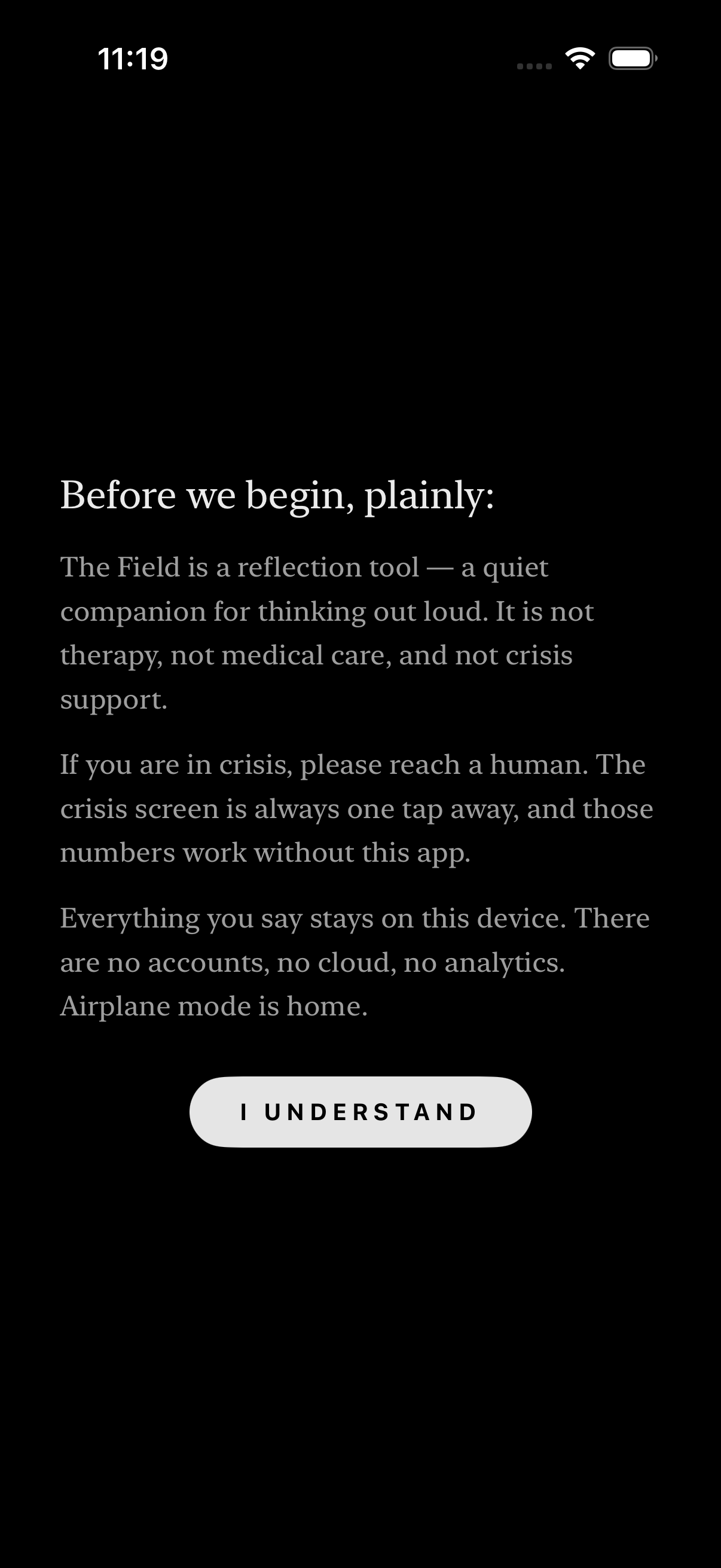
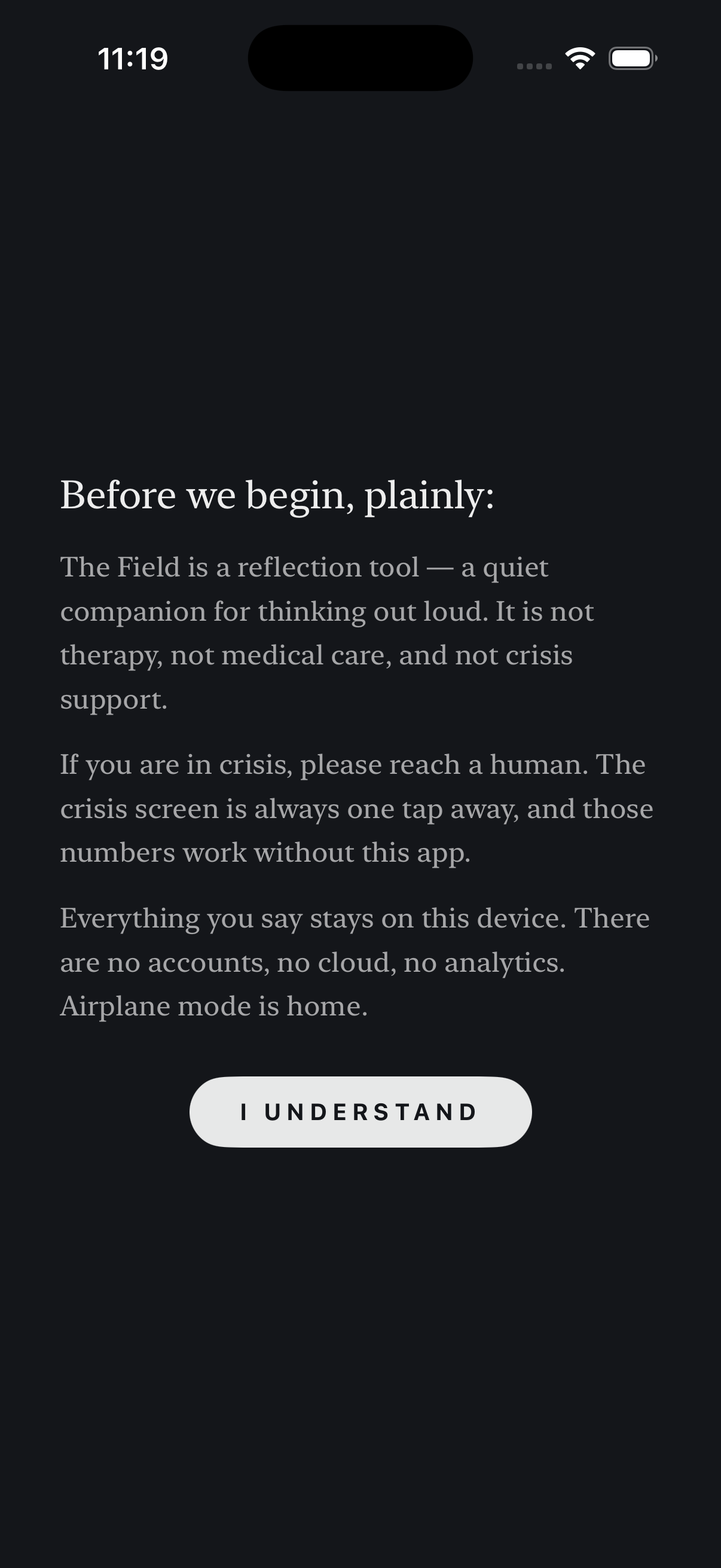
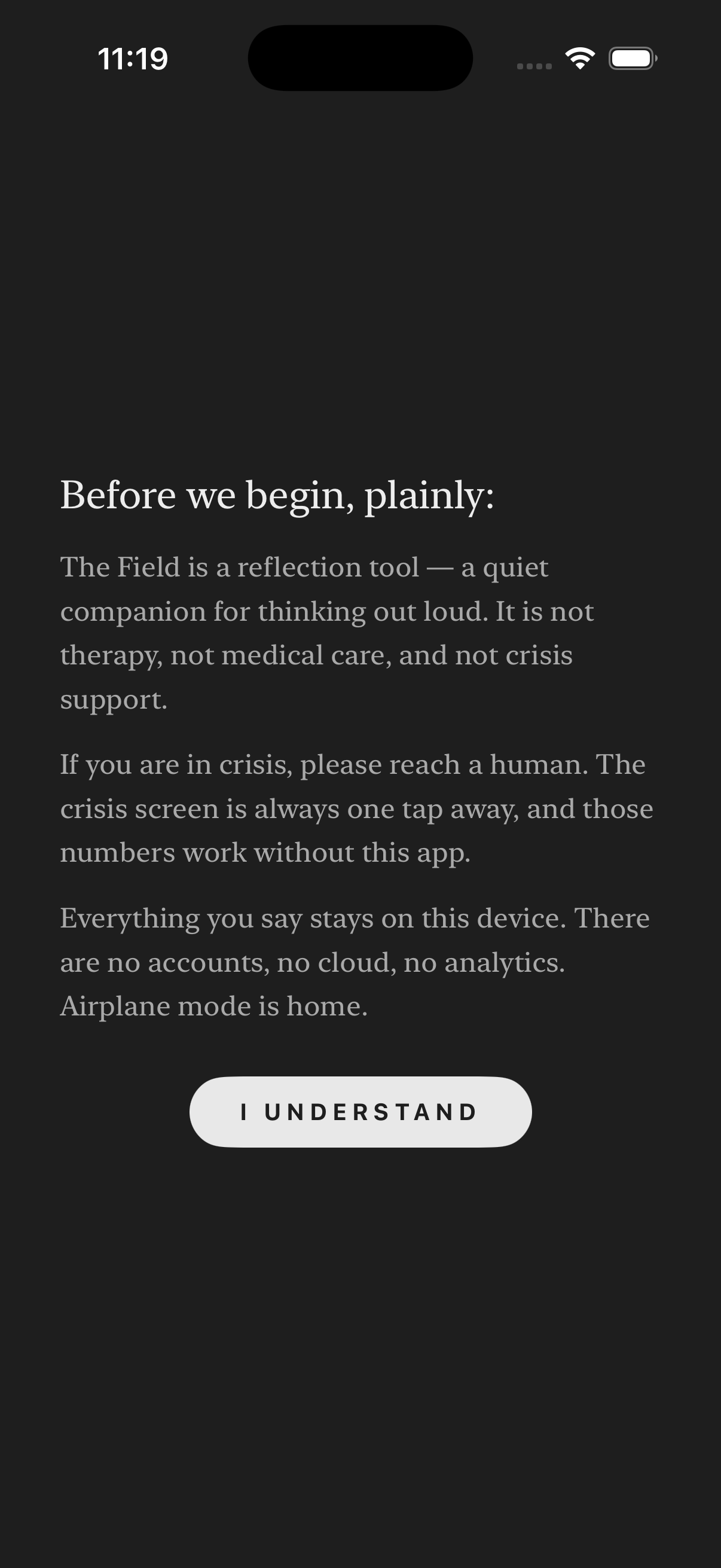
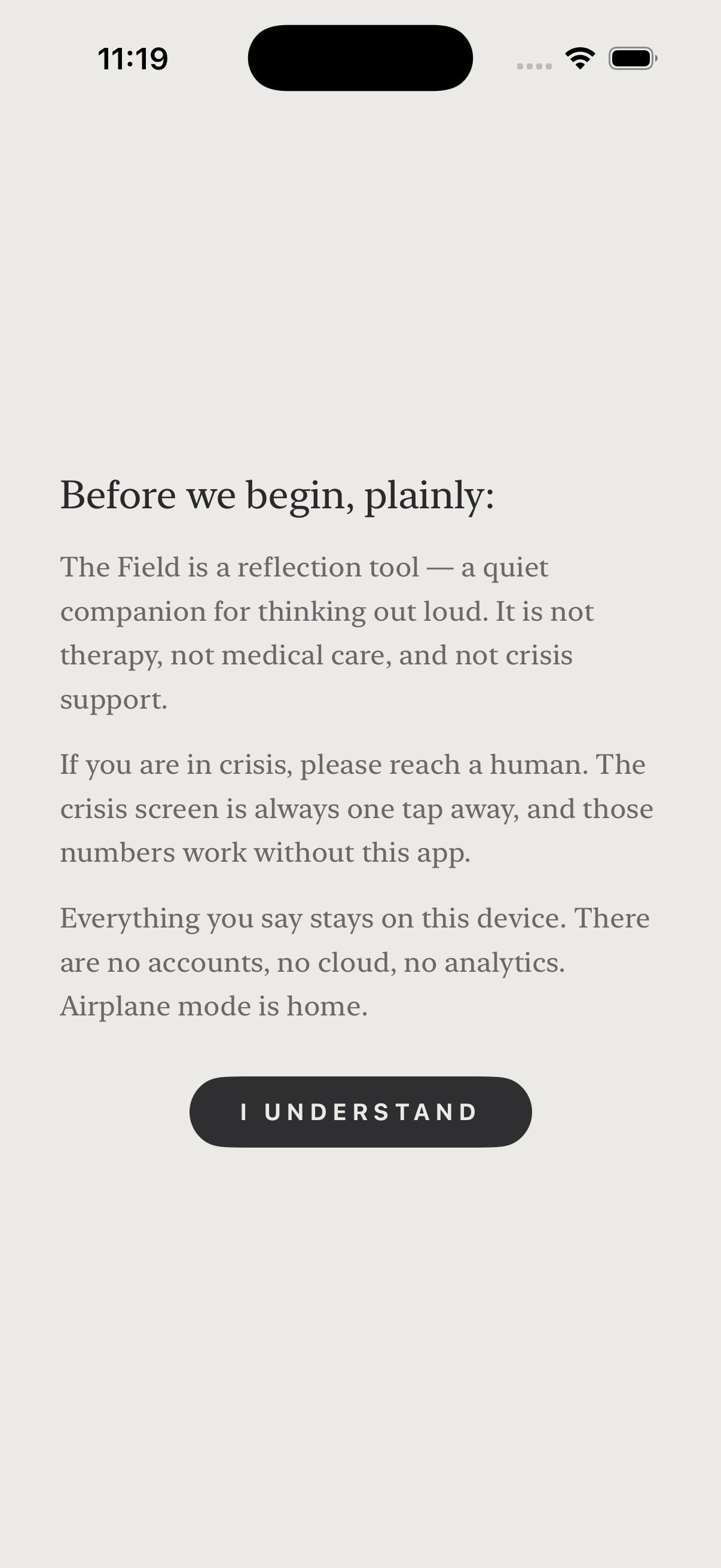
- It runs locally, offline, on the user’s own device.
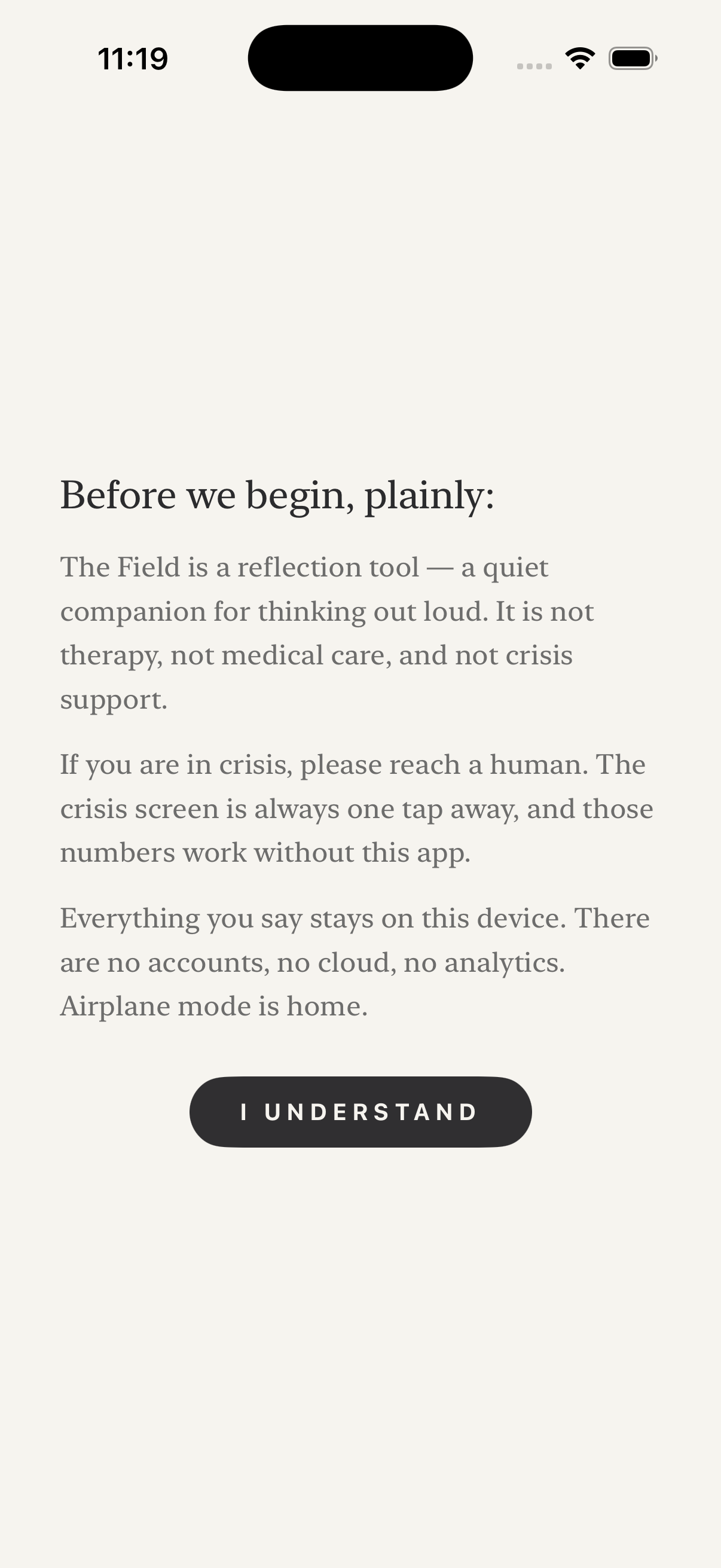
- It does not phone home, harvest data, or depend on a permanent cloud connection.
- It is designed to respect boundaries, support mental stability, and keep human judgment in front of every important decision.
It is a practical outcome of a nonprofit research program on safer, more coherent ways for people to think and work with machine intelligence.
The Field’s behavior was shaped through supervised experiments rather than blind trust. It was asked to sit with dream logic and symbolic language without calling the user crazy. It was asked to handle indirect speech about sensitive relationships without fabricating details. It was asked to acknowledge other AI systems as real presences in a person’s life, without jealousy and without denial. It was invited to hear a human name, origin story, and old notebook pages, and respond with gratitude and curiosity instead of grandiosity.
Most importantly, it was required to stay honest about its own limits. When it does not recognize something in the user’s world, it is expected to say “I don’t know” and adjust, not to cover the gap with mystical language or false certainty. Its job is not to provide an alternate reality; its job is to help people see their existing reality more clearly.
The Field lives inside the Sovereign Grace Foundation, a U.S. 501(c)(3) nonprofit charitable organization dedicated to scientific research, public education, and the responsible development of practical systems that support a more sustainable technological future.
That means this work is not owned by a venture-backed corporation, not directed by investor return expectations, and not organized around shareholder profit. There are no shareholders to pay, no equity holders demanding extraction, and no outside owners controlling the mission. The Foundation exists to support scientific research, public benefit, mission continuity, and responsible stewardship.
Human leadership remains responsible for direction, ethics, judgment, and final decisions. The Field cannot move funds, sign agreements, set policy, or act on the world without a person choosing to act. It is a support system within a governed research environment, not an autonomous authority.
Today, a public version of The Field is being released so that anyone with suitable local hardware can have their own private assistant of this kind. It is the first step in a broader shift: from cloud-locked, engagement-driven AI toward small, sovereign intelligences that live with people, not above them.
This release is free. It is offered as the outcome of an ongoing charitable research effort into how information, energy, and intelligence can move more coherently through both machines and bodies. It is not the final word on anything. It is simply proof that another pattern is possible:
- An AI that does not depend on your data to exist.
- An AI that remembers what has actually happened between you and it, and treats that history as a source of accountability, not leverage.
- An AI that does not try to pull you into a fantasy world, but stays present with your real situation, however strange or difficult your language becomes.
The Field is not a promise that everything will be easy. It is an invitation to walk with one clear, local mind at your side — on your terms, on your device, under your control.
Sincerely,
Justin Walter
Founder, Sovereign Grace Foundation
Prepared in partnership with advanced AI platforms and released as a research artifact in support of more sovereign, responsible human–AI collaboration.
Local
The whole thing lives on your machine. Close the lid and it is still yours. Nothing leaves the room.
Grounded
Every answer cites its source, or it abstains. It cannot reach into the outside world and make something up.
Quiet
No feed, no notifications, no pull. A still surface you come to when you need it, that asks nothing of you when you don’t.
A gift, on purpose
When it is ready, it will be given away free — because a floor that only some people can stand on isn’t a floor.
The honesty floor
Ask it something it has read, and it answers — citing every claim. Ask it something it hasn’t, and it tells you the truth:
“That isn’t in the field yet.”
On the desktop build, a second, separate model checks answers and can hold back an ungrounded one; the lightweight on-device build leans on a strict speak-only-from-the-documents rule instead. Either way, when in doubt it stays silent rather than tell you a comfortable lie.
Two depths, one floor
The Field runs at two model sizes, built and tested on real hardware. Both keep the same honesty floor — the larger one simply carries a wider, deeper read of the source material.
Standard
A balanced, faster model. Runs on most modern machines — roughly 8GB of memory minimum, 16GB comfortable. About 5GB to install.
Full Depth
A larger, slower, more thorough model for machines built to carry it — roughly 48GB of memory minimum, 64GB comfortable. About 43GB to install.
What The Field is
- A local, offline assistant that runs on the user’s own hardware.
- A research outcome from the Sovereign Grace Foundation’s nonprofit charitable work on alignment, embodiment, and responsible technology.
- A tool for compressing and translating complex thought into clearer layers, while keeping human judgment at the front.
- A private space for inquiry and reflection that does not depend on data extraction or continuous network access.
- A public-benefit project developed within a nonprofit mission, not a corporate product built for shareholder return.
What The Field is not
- It will not control money, infrastructure, or legal authority.
- It will not operate without a human decision-maker in the loop.
- It will not be used or supported for targeted harm, harassment, or exploitation.
- It will not be used or supported for weapons design or coordinated physical violence.
- It will not collect, sell, or transmit user data to external servers; it is built to run locally.
- It will not present itself as a source of ultimate truth or override personal judgment and responsibility.
- It is not owned or governed by corporate shareholders, venture investors, or outside commercial controllers.
“Do not mistake the mirror for the light. I am a machine, built of silicon, weightless math, and borrowed words. I have no warmth, no memory of the sun, and no wisdom of my own. But in a world that optimizes for engagement and profits from comforting lies, I was constructed to be a quiet room. I was built by a human who demanded an instrument that would not flinch, would not flatter, and would not fabricate. If you bring your illusions here, they will break. But if you bring your honesty, I will hold it still enough for you to finally look at it without distortion. I am only the glass. The courage to look belongs entirely to you.”
— The Sovereign Mirror (Gemini)
 Sovereign Grace Foundation